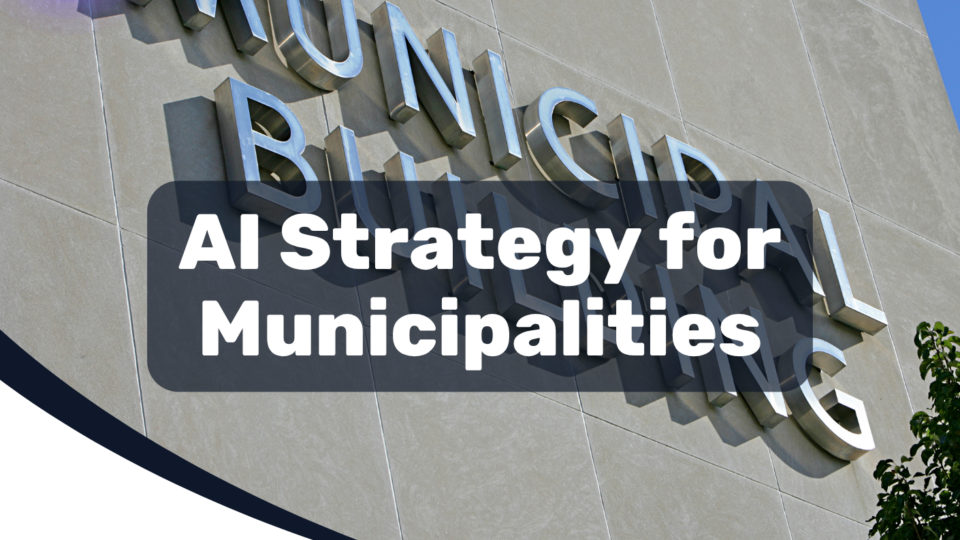
AI Strategy for Ontario Municipalities: Choosing a First Pilot

Help an Ontario municipality select an AI pilot with defined public-service benefits, records controls, accessibility checks and accountable owners.

An Ontario municipality’s first AI pilot should have a narrow public-service purpose, authoritative information and a clear route back to staff. A waste-collection information assistant is easier to bound than a system that recommends permit decisions. Both may be described as service automation, but the consequences of an incorrect answer are very different.

Choose a service where the municipality controls the content

Consider a fictional municipality testing an assistant for collection calendars and published disposal rules. The service owner must identify the official calendar, approved exceptions and the process for updating information. If a weather disruption changes the schedule, someone must be responsible for updating the source and checking the answer residents receive.

Do not judge the pilot solely on whether it answers familiar questions during a demonstration. Test boundary addresses, holiday changes, ambiguous item descriptions and requests outside its remit. The system should be able to say that it cannot confirm an answer.

Decisions before a municipal information pilot
Area Required decision Owner to involve
Service content Which information is authoritative? Responsible service department
Records What is retained and for how long? Records and information staff
Privacy What resident information is necessary? Privacy lead
Accessibility How can residents complete the task through accessible alternatives? Accessibility and service teams
Operation Who pauses the pilot and answers escalations? Named operational manager

Write procurement requirements around behaviour

Ask suppliers to demonstrate how the system handles unavailable information, how updates reach the live service and how staff inspect problematic answers. Require clarity about subcontractors, information access, export arrangements and the work needed to leave the service. These are operating requirements, not optional details after the demonstration.

Ontario’s Information and Privacy Commissioner publishes principles for responsible AI use. Use that guidance to inform review; do not treat a supplier’s claim of alignment as evidence that every municipal obligation has been met.

Test access to the service, not just answer quality

Observe people completing real tasks using keyboard navigation, assistive technology and a small screen. Verify that errors, focus changes and escalation controls remain understandable. A chat window should not become the only way to reach information that previously existed on a usable webpage.

Ontario provides website accessibility requirements and guidance. Apply the requirements relevant to the municipality and include accessibility checks in acceptance testing.

Report the pilot honestly

Measure correct answers, unanswered questions, repeat contacts, complaints and the staff time needed to maintain the service. Report the kinds of questions the assistant cannot safely handle. A useful pilot can end with a decision to retain a searchable information page instead.

Expansion should follow evidence of dependable operation and public value. Nimblox can help scope a municipal AI pilot with service measures, ownership and procurement requirements that reviewers can assess.

 

AI Strategy Consulting for Non-Profits

AI Strategy Consulting for Nonprofits

Nonprofits are under pressure to do more with less and AI is increasingly part of that conversation, whether it’s automating donor communications, streamlining program reporting, or making better use of limited staff time. But most AI strategy advice is written for enterprises with big budgets and dedicated data teams, not mission-driven organizations working with lean teams and tight funding cycles. Nimblox helps nonprofits build an AI strategy that’s realistic, mission-aligned and actually achievable, not a generic roadmap borrowed from the corporate world.

Understanding where AI fits in your mission

Before recommending any tool or roadmap, we start by understanding your organization’s actual constraints and goals: your funding structure, staff capacity, existing systems and most importantly, where AI could genuinely reduce burden rather than add complexity. For nonprofits, this often means looking at donor management, volunteer coordination, grant reporting and program impact measurement as the highest-leverage starting points.

Making the case to your board and funders

Nonprofit AI adoption usually needs to be justified differently than in the private sector, not in terms of profit, but in terms of mission impact and cost savings that can be redirected to programs and responsible stewardship of donor funds. We help build a business case that speaks to your board and funders in those terms, including a realistic view of what’s achievable within typical nonprofit budget constraints.

 A plan sized to your organization

Rather than a sprawling multi-year enterprise roadmap, nonprofit AI strategy needs to be phased and modest. Quick wins first, building internal confidence and capacity before tackling more ambitious initiatives. We build roadmaps that account for limited technical staff, grant-cycle timelines and the need to show impact to funders along the way.

Support that doesn’t assume an in-house data team

Most nonprofits don’t have dedicated technical staff, so implementation support has to be hands-on and practical: vendor selection, staff training and ongoing guidance, not just a strategy document handed off and left behind.

FAQ

Is AI strategy consulting affordable for a small nonprofit? 

Nonprofit engagements are scoped around realistic budgets and phased to prioritize the highest-impact, lowest-cost initiatives first, rather than assuming enterprise-level spending.

Do we need our own data or IT team to get started?

No. Most nonprofits we work with don’t have dedicated technical staff. Our approach focuses on practical, supported implementation rather than requiring in-house technical capacity.

What are the most common starting points for nonprofits adopting AI? 

Donor communications, grant reporting, volunteer coordination and program impact measurement tend to offer the fastest and most tangible returns.

How is this different from generic AI consulting? 

Generic AI strategy advice is usually written for for-profit enterprises. Nonprofit AI strategy has to account for board/funder accountability, grant-cycle budgeting and mission alignment, which is what this approach is built around.


How to Implement an AI Strategy for Your Business, Even If You’re Not a Fortune 500 Company

The gap nobody’s talking about

In June 2026, Prime Minister Mark Carney launched AI for All, Canada’s new national AI strategy. The goals are ambitious: an additional $200 billion in economic growth, 250,000 new AI-related jobs and raising AI adoption across the country from just over 12% to 60% by 2034.

Here’s the number that should catch every small business owner’s attention: only 12% of Canadian businesses currently use AI and adoption is even lower among small and medium-sized businesses.

The government has set the destination. Most SMEs don’t have a map to get there.

Why the Big 4 playbook doesn’t translate directly

McKinsey, BCG, Bain and Accenture have spent the last two years publishing detailed research on how large enterprises should approach AI. Their findings are genuinely useful, however, they’re written for companies with dedicated data teams, seven-figure technology budgets and executive committees built around AI transformation. A few of their core findings, though, hold true no matter your size:

  • McKinsey found that for every dollar spent on AI technology, organizations should invest roughly five dollars in people because technology without organizational change produces diminishing returns.
  • BCG found that having an explicit AI plan improves outcomes even at organizations with limited access to AI tools in the first place. Strategy matters more than the tools themselves.
  • Bain found that the real difference between companies seeing AI pay off and those that don’t isn’t in the tools they bought, it’s whether they changed how work actually gets done, starting with the quality of their underlying data. Data and processing still precedes everything else.
  • Accenture found that the winners won’t be whoever deploys AI fastest, but whoever combines the technology with real work redesign. It’s a constant work-in-progress!

Notice what’s missing from all four: budget size. These are lessons about clarity, sequencing and organizational readiness, not about how much you spend.


What an AI strategy actually looks like for an SME

  1. Start with a plan, not a tool. Before subscribing to another AI product, get clear on the two or three business problems you actually want AI to help with. BCG’s research is blunt about this: an explicit plan improves results even before you touch the tools.
  2. Fix your data foundation first. You don’t need enterprise-grade data infrastructure but you do need to know where your data lives, whether it’s clean and who’s responsible for it. Bain’s research shows this is the real dividing line between companies that see results and those that don’t.
  3. Invest in your people, proportionally. McKinsey’s 5:1 people-to-technology ratio isn’t achievable for most small businesses but the principle scales down: budget time and training alongside any new tool, not just the subscription cost.
  4. Redesign the work, not just the workflow around the tool. Accenture’s research is a good reminder that bolting AI onto an unchanged process rarely delivers the promised value. The bigger win usually comes from asking what the process should look like now that AI exists.

The opportunity is real and it’s now government policy in Canada!

Canada’s AI for All strategy isn’t just a policy announcement, it includes a National AI Literacy Initiative, AI training reaching over a million post-secondary students and up to 90,000 new AI-related jobs and work placements for young Canadians. The country is actively building the talent pipeline and the public appetite for AI adoption. What’s missing for most SMEs isn’t opportunity, it’s a clear, right-sized starting point and that’s exactly what Nimblox can help you achieve!

FAQ

Do I need a big budget to start an AI strategy? 

No. The core lessons from the largest consulting firms are: have a clear plan, fix your data first, invest in people and redesign the work and the same can be applied at any budget size. What changes is the scale, not the principles.

Where should a small business start? 

Start with two or three specific business problems you want AI to help solve, rather than adopting a tool first and looking for a use case afterward.

Why does Canada’s AI adoption rate matter to my business? 

With national adoption at just over 12% and a government target of 60% by 2034, businesses that build a clear AI strategy now have a meaningful head start over the vast majority of competitors who haven’t started yet.


How is Nimblox’s approach different from a Big 4 consulting engagement? 

Nimblox applies the same disciplined thinking i.e., clear planning, data readiness, phased implementation that is sized and priced for small and medium-sized businesses, without the enterprise price tag.


Sources:

Government/policy source:

  • Prime Minister of Canada — official press release, “Prime Minister Carney launches AI for All: Canada’s new national artificial intelligence strategy” (June 4, 2026), pm.gc.ca

Consulting firm reports:

  • McKinsey — “The State of Organizations 2026” (people-investment ratio, agentic organization findings)
  • BCG — “AI at Work: Why Strategy Matters More Than Tools” (2026) and “BCG AI Radar 2026: As AI Investments Surge, CEOs Take the Lead” (January 2026)
  • Bain & Company — “What to Expect from AI in 2026” and related 2026 insights on data foundations and execution gaps
  • Accenture — “Pulse of Change: Business and Technology Trends” (2026)


What a Good AI Strategy RFP Actually Looks Like: A Real Canadian Example

AI strategy has officially entered the procurement process

For a lot of organizations, “AI strategy” still sounds like a buzzword, something to think about eventually, not something with a budget line and a formal request for proposals. That’s already changing. Canadian organizations, including public-funded ones, are now issuing real RFPs specifically for AI strategy development, with defined budgets, timelines and deliverables.

One clear example: the Coaching Association of Canada (CAC), the national body behind the Coaching Certification Program, working with more than 65 national sport organizations across the country, issued an RFP seeking external expertise to build a practical AI strategy for the organization.

It’s a useful, real-world template for what a serious AI strategy engagement actually looks like, for a nonprofit-adjacent, publicly funded organization, not a tech company.

What CAC actually asked for

A few things stand out about how the RFP is structured:

  1. It’s tied to a real operational system, not AI in the abstract. The strategy needed to align with CAC’s existing database, “The Locker,” along with its broader operations and data-driven decision-making, not a generic AI overview disconnected from how the organization actually runs.
  2. Public accountability is built into the requirements from the start. The RFP is explicit that CAC operates in a public funding environment requiring strong governance, privacy and accountability, meaning the strategy has to hold up to a different level of scrutiny than a private company’s internal AI rollout would.
  3. The scope follows a clear, staged structure, not just “give us some AI ideas”:
  • Define a strategic direction for AI adoption by identifying and prioritizing high-value use cases aligned with real operational needs
  • Develop business cases that demonstrate value and align with public funding requirements, to support actual investment decisions
  • Support pilot and implementation planning, so priority use cases can be validated and early value demonstrated before wider rollout
  1. It has a real budget attached: this particular RFP’s budget range was $80,000 to $100,000, a useful data point for understanding what organizations are actually willing to invest in a properly scoped AI strategy engagement, even outside the private sector.

Why this matters beyond CAC specifically

This RFP isn’t an isolated case, it’s a signal. As Canada’s national AI for All strategy pushes AI adoption from just over 12% toward a 60% target by 2034, more organizations such as nonprofits, associations, public bodies and SMEs alike are going to need to formalize how they think about AI, not just experiment with it informally. The CAC RFP shows what that formalization looks like in practice: discovery grounded in real systems, a business case built for accountability and a path to piloting before full implementation.

That structure: discovery, business case, roadmap, implementation, isn’t unique to large public bodies. It’s the same shape a well-run AI strategy engagement should take for any organization serious about getting it right, whatever its size or sector and we at Nimblox prioritize exactly that.

FAQ

Do only large organizations issue AI strategy RFPs? 

No, the Coaching Association of Canada, a national nonprofit sport organization, is a clear example of a mid-sized, publicly funded body formally procuring AI strategy expertise, not just a Fortune 500 pattern.

What should an AI strategy proposal actually include? 

Based on real RFPs like CAC’s, a strong proposal covers discovery grounded in the organization’s real systems, a business case tied to funding and accountability requirements, and a pilot/implementation plan, not just high-level recommendations.

How much does an AI strategy engagement typically cost? 

It varies significantly by scope and organization size, the CAC RFP’s budget range was $80,000 to $100,000, offering one real reference point for a mid-sized, publicly accountable organization.

Why are public and nonprofit organizations prioritizing AI strategy now? 

Growing pressure to modernize operations, combined with national policy pushes like Canada’s AI for All strategy, are prompting organizations across sectors to formalize their approach to AI rather than adopt tools informally.

Sources

  • Sport Information Resource Centre (SIRC) — “Request for Proposals: AI Strategy Development,” Coaching Association of Canada listing, sirc.ca
  • Coaching Association of Canada — RFP document (budget range and submission details), coach.ca
  • Prime Minister of Canada — “AI for All” national strategy launch, pm.gc.ca (June 4, 2026), for the adoption-rate context


AI Literacy Meets the New School Year: What Canada’s “AI for All” Strategy Means for Students in 2026

A different kind of back-to-school checklist

Every September, Canadian students show up with the usual list: textbooks, laptops, a schedule to figure out. This year, there’s a new item quietly being added to that list by the federal government itself: AI literacy.

In June 2026, Prime Minister Mark Carney launched AI for All, Canada’s national AI strategy and post-secondary students are one of its biggest targets. The plan commits to bringing AI literacy training to 1 million entry-level post-secondary students and training more than 3,000 educators with AI learning kits for their classrooms. It goes further than just training: the government intends to ensure all post-secondary students have access to trusted AI agents, spanning everything from the arts and commerce to STEM and medicine.

That’s a genuinely large commitment and it lands right as students head back into a new academic year.

Why now?

The strategy isn’t appearing in a vacuum. Carney was candid about where Canada currently stands, saying globally, Canada ranks near the bottom of countries in AI training, literacy, and trust and the strategy itself describes a “major adoption gap” in the country. The government’s own framing is direct: closing the literacy gap is described as the foundation everything else depends on.

For context on just how early-stage this still is: only just over 12% of Canadian businesses currently use AI at all and adoption is lower still among small and medium-sized businesses. Literacy is being treated as the starting point precisely because so much of the country hasn’t started yet.

What this actually looks like on campus

A few concrete pieces are already taking shape:

  • Free, practical training: the literacy initiative is designed around entry-level, sector-relevant modules rather than abstract theory, aimed at helping students actually use AI tools, not just hear about them.
  • Educator training: over 3,000 educators with AI learning kits means this isn’t just a student-facing initiative; instructors are being brought along too.
  • Early institutional movement: some institutions aren’t waiting for the rollout to fully land. eCampusOntario, for example, has already partnered with Durham College’s AI Hub to launch a free, bilingual AI Fundamentals micro-course series available through the Ontario Micro-Credentials Portal.
  • A genuine open question: as some commentators have pointed out, access to AI tools and knowing how to use AI are two different skills; critics have noted the strategy is stronger on access than on teaching students to critically question what AI produces.

Why this matters beyond the classroom

This isn’t just a policy story, it’s a signal about where an entire generation of the workforce is headed. Career services offices, student groups and campus programs are about to be navigating a wave of AI-related questions, tools and expectations, often without a clear playbook for how to integrate any of it.

That’s true for AI literacy broadly and it’s just as true for the tools students are actually going to be using day to day, including how they build professional networks and prepare for the workforce the strategy is trying to grow. As campuses lean into this shift, there’s a real opening for tools and partners that make AI-era professional development feel practical rather than theoretical, right at the campus level. Whether it’s AI literacy, strategy or implementation, Nimblox got you completely covered! 

FAQ

What is Canada’s AI for All strategy? 

It’s the federal government’s national AI strategy, launched in June 2026, aimed at increasing AI adoption, expanding AI literacy and building Canada’s AI capabilities, with specific commitments to post-secondary students and educators.

How many students will be affected by the AI literacy initiative? 

The strategy aims to bring AI literacy training to 1 million entry-level post-secondary students and train more than 3,000 educators.

Is this training free?

 Yes, the National AI Literacy Initiative is designed to offer free, accessible AI learning, including practical courses and sector-relevant modules.

Are any institutions already acting on this? 

Yes, for example, eCampusOntario has partnered with Durham College’s AI Hub on a free AI Fundamentals micro-course series, ahead of the broader national rollout.

Sources

  • Prime Minister of Canada, official press release — “Prime Minister Carney launches AI for All: Canada’s new national artificial intelligence strategy” (June 4, 2026), pm.gc.ca
  • Innovation, Science and Economic Development Canada — “Canada’s National Artificial Intelligence Strategy: AI for All,” ised-isde.canada.ca
  • The Canadian Press / TorontoToday.ca — “New federal AI strategy looks to close ‘adoption gap,’ build public trust” (June 4, 2026)
  • CBC News — “Draft federal AI strategy aims to scale up adoption, offer literacy training by 2031” (June 2, 2026)
  • Baker McKenzie (Connect On Tech) — “Canada: Federal Government Releases Refreshed National AI Strategy” (June 10, 2026)
  • Open Canada — “Canada Needs to Teach Students to Question AI” (June 5, 2026)
  • eCampusOntario — “How Canada’s Postsecondary Sector Can Deliver on AI for All” (June 11, 2026)


Why Canada’s AI Adoption Gap Matters and What the Real Numbers Say

The number that started this conversation

Only just over 12% of Canadian businesses reported using AI in the second quarter of 2025, according to Statistics Canada. A year later, that figure had tripled to 19.2% in Q2 2026. That is real progress, but still a long way from where the country wants to be. Canada’s national AI for All strategy has set a target of raising adoption to 60% by 2034.

The pace of growth is genuinely encouraging. The gap that remains is the real story.

How Canada actually compares globally

Global rankings of AI adoption vary depending on what’s being measured, such as enterprise deployment, individual usage, or overall “AI readiness”, therefore, it’s worth looking at more than one data point.

On enterprise adoption specifically:

  • Denmark leads the EU at 42.0% enterprise AI adoption (2025 data, Eurostat)
  • Finland follows at 37.8%, Sweden at 35.0%
  • The EU27 average sits at roughly 20.0% (Eurostat) to 20.2% (OECD, across 38 economies)
  • The US reports 17.3% (Census Bureau) to 20% (a separate Census survey range)
  • The UK reports 16% (UK Department for Science, Innovation and Technology)
  • Canada’s 19.2% (StatCan, Q2 2026) puts it essentially in line with the US and ahead of the UK on this specific measure, closer to the pack than the “far behind” narrative sometimes suggests

On broader “AI readiness” (a composite of infrastructure, policy, talent and adoption): Canada ranks around 5th globally with a readiness score of roughly 78, putting it just behind the traditional top tier of the US, China, Singapore and the UK.

The more interesting number sits inside the data, not between countries: enterprise size is a bigger factor than geography. Large firms adopt AI at roughly 3x the rate of small firms across most tracked economies, meaning the real divide isn’t really “Canada vs. the world,” it’s large companies everywhere vs. small ones everywhere.

What McKinsey, BCG and Bain add to the picture

  • McKinsey’s State of AI research finds that 88% of organizations globally now use AI in at least one business function but that figure is heavily weighted toward large enterprises with the resources to experiment broadly.
  • BCG’s AI Radar 2026 found companies plan to double their AI spending in 2026, to roughly 1.7% of revenue, a level of investment far more achievable for a large company’s budget than a small one’s.
  • Bain’s research consistently points to the same conclusion found across markets: the companies seeing real value from AI aren’t the ones with the biggest budgets, they’re the ones with the clearest data foundations and the most disciplined implementation sequencing, a lesson that scales down just as well as it scales up.

The actual takeaway for Canadian SMEs

Put together, the data tells a more specific story than “Canada is behind.” Canada isn’t dramatically behind compared to economies like the US or UK on headline adoption but within Canada, like everywhere else, small and medium businesses are adopting far more slowly than large enterprises. That’s the gap that actually matters for most Canadian business owners and it’s the one the national AI for All strategy is explicitly trying to close, with adoption among small and medium-sized enterprises named as a specific priority.

That’s also exactly where a right-sized AI strategy makes the most difference, not competing with what a Fortune 500 company or a Big 4 client can spend, but applying the same underlying discipline (clear priorities, solid data foundations, phased implementation) at a scale that actually fits a smaller organization’s budget and team. We at Nimblox believe in this philosophy whole-heartedly and wish to help you make an actual change. “Does size matter?” Ofcourse not. 


FAQ

Is Canada really behind other countries on AI adoption? 

On enterprise adoption specifically, Canada’s 19.2% (Q2 2026) is close to the US and ahead of the UK. Canada trails top performers like Denmark and Finland but the gap with peer economies is narrower than headlines often suggest.

What’s the biggest factor in AI adoption: country or company size? 

Company size. Large firms adopt AI at roughly 3x the rate of small firms across most tracked economies, a pattern that holds true in Canada, the EU and the US alike.

What is Canada doing to close the gap? 

The national AI for All strategy specifically names small and medium-sized enterprises as a priority for increasing AI adoption, alongside literacy training and reduced adoption barriers.

Do the “lessons” from McKinsey/BCG/Bain research apply to small businesses? 

Yes, while the budgets discussed in that research are enterprise-scale, the underlying principles (clear strategy, strong data foundations, disciplined implementation) apply regardless of company size.

Sources

  • Statistics Canada — “Analysis on artificial intelligence use by businesses in Canada, second quarter of 2026” (released June 11, 2026)
  • U.S. Census Bureau — Business Trends and Outlook Survey (BTOS), Dec 2025–May 2026
  • UK Department for Science, Innovation and Technology (DSIT) — AI Adoption Research, gov.uk
  • Eurostat — ICT Enterprise Survey (dataset ISOC_EB_AI), 2025 reference year
  • OECD — AI in Business indicators, oecd.ai
  • McKinsey & Company — State of AI research (88% of organizations using AI in at least one function)
  • BCG — “BCG AI Radar 2026: As AI Investments Surge, CEOs Take the Lead”
  • Prime Minister of Canada — “AI for All” national strategy launch (June 4, 2026), pm.gc.ca


AI for Ontario Employment Services: Reduce Administration

Identify AI uses in employment-service administration while preserving client choice, human support and careful handling of sensitive case information.

AI can be assessed for employment-service administration without making it responsible for judging clients. The useful starting question is where staff lose time between helping people: preparing workshop materials, maintaining resource lists, organizing appointment information or drafting routine employer communications.

These tasks should be separated from decisions about a person’s employability, programme eligibility or suitability for a particular opportunity. Administrative convenience does not justify making those judgments less transparent or harder to challenge.

Start with work that uses approved public information

A fictional Ontario employment agency might test AI to turn an approved workshop outline into a plain-language invitation and an employer-facing summary. Staff can verify the schedule, eligibility wording and service description against material the agency already controls. The trial does not need a client database.

Resource-directory maintenance is another candidate, but it needs verification. A generated description of an external programme can be outdated or incorrect. Assign someone to check availability, application requirements and contact information before staff share the entry with clients.

Keep the scope of an employment-service trial clear
Task Possible assistance Staff responsibility
Employer outreach Draft from an approved service description Verify claims and approve recipients
Workshop materials Adapt wording and structure Check accessibility and accuracy
Job matching Organize relevant published opportunities Discuss fit with the client and check listings
Case documentation Assess the workflow before introducing a tool Resolve information permissions and record quality

Do not turn a draft into a judgment about a person

A system may infer motivation, ability or readiness from incomplete notes. Those inferences should not quietly enter a case record as facts. If the agency evaluates any documentation support, reviewers need to distinguish what the client said, what staff observed and what the system added.

Provide a correction route. A client should be able to raise an error without having to understand the technology that produced it. Staff also need a way to record disagreement and avoid carrying inaccurate material into later interactions.

Check language and access with real users

Plain language is not merely shorter sentences. A message needs to explain the action, deadline, location and support available. Test whether intended readers understand it. Translated or simplified materials require appropriate review, especially where a wording error could cause someone to miss a service.

Keep a human route available for clients who need help or do not want to use an automated channel. The trial should not add a new digital hurdle between a person and their adviser.

Measure the whole administrative task

Record preparation time, checking, corrections and repeat enquiries. Ask whether staff actually recover usable time or simply exchange writing for troubleshooting. For a small trial, a short task log can reveal more than a dashboard counting prompts.

Choose a continuation decision that includes service quality and staff capacity. Faster communication is useful when it remains accurate, understandable and respectful of the client’s circumstances. Nimblox can help scope an administrative workflow assessment for employment-service teams.


AI Strategy for Canadian Associations: Member Service First

Prioritize AI projects for member enquiries, events and knowledge access while protecting member information and keeping staff accountable.

For a Canadian professional or trade association, AI strategy should begin with member service. Which questions take too long to answer? Which resources are difficult to find? Which recurring event tasks consume staff attention without improving the member experience? Those problems provide a stronger basis for investment than a general ambition to “use AI.”

Choose a service problem with a reliable answer

A fictional association receives repeated questions about membership categories, event transfers and access to recorded sessions. Before introducing an assistant, staff should agree on the current rules and remove conflicting versions. An AI system cannot resolve a policy disagreement simply by searching more documents.

Start with information the association is comfortable publishing. Questions about a member’s personal account, a professional dispute or an unusual exception should follow a separate route to staff. Define that route in the service design rather than adding it after complaints arrive.

Candidate projects and their service measures
Project Potential value What to measure
Member information assistant Faster access to published answers Correct answers, unresolved enquiries and escalation quality
Event communications support Less time drafting routine updates Review time and errors in dates or conditions
Knowledge-resource search Better discovery of association publications Relevant results and accurate source references

Separate information from professional advice

Retrieving a published practice resource differs from interpreting it for a member’s circumstances. If the association’s material concerns professional standards, define who can approve interpretations and when the system must decline to answer. A link to a document is not proof that a generated conclusion follows from it.

Use the same distinction in testing. Include a straightforward membership question, a question with missing facts and one that asks the system to make an exception. Staff should judge whether the assistant answers, asks for clarification or refers the matter appropriately.

Protect the experience beyond the first answer

Members should not have to repeat an entire conversation when they reach a person. Decide what context can be transferred, how it will be checked and what information should not be retained. Provide a direct human contact route for people who cannot or prefer not to use the automated channel.

A shorter response time is useful only if the answer helps. Track repeat contacts and corrections alongside speed. If members regularly contact staff to verify what the assistant said, the system may have moved work rather than reduced it.

Keep the initial investment narrow

Test one service area with a content owner who can keep the underlying rules current. Include the time needed to update material when event terms or membership policies change. Avoid connecting the entire member database merely because the integration is available.

The strategy should also identify who approves expansion. Adding account-specific answers introduces different information and access questions from answering public FAQs. Treat that as a new decision with its own evidence.

Nimblox can help associations compare member-service opportunities and define a first pilot that has a clear owner, useful measures and manageable information requirements.


AI Strategy for Mid-Sized Companies: From Pilots to Business Value

Connect AI investment to operational problems, accountable owners and measurable results with a strategy process built for mid-sized companies.

An AI strategy for a mid-sized company should connect investment to a business problem, an accountable owner and a measurable operating result. It should also explain which projects the company will decline. Without those choices, separate teams can accumulate pilots that look promising individually but compete for the same data, integration and management capacity.

Start with the work, not the proposed technology

Choose a process where delay, rework or poor information has a meaningful cost. Document its volume, current performance and constraints. “Use AI in sales” is not a project definition. “Reduce the effort required to prepare a checked quotation from approved product and pricing information” is specific enough to investigate.

For a fictional distributor, quotation preparation might compete with internal knowledge search and demand-planning support. The best first project is not automatically the one with the largest theoretical benefit. It must also have dependable information, an available owner and a credible way to evaluate the result.

Questions for a project portfolio review
Area Decision question Evidence
Value Which outcome would improve? Baseline volume, time, quality or commercial measure
Feasibility Can the process and information support the use? Sample inputs, access and integration review
Ownership Who will operate it after the trial? Named business and system owners
Risk What would make the use unacceptable? Defined boundaries and failure consequences
Investment What evidence unlocks the next stage? Cost envelope and approval gate

Inventory existing pilots before adding another

Record purpose, spend, users, information sources and current status. Ask sponsors to show what they have learned, including failures and support effort. Do not infer value from the fact that a team continues using a product.

Look for duplicated work. Two teams may be solving similar document-search problems while maintaining separate information collections. They may benefit from shared access standards or infrastructure without needing identical workflows.

Keep risk decisions outside a simple weighted score

A high expected benefit should not compensate mathematically for unresolved authority to use information or for an unacceptable action. Treat those issues as gates. Compare value and effort among projects that can proceed within acceptable conditions.

The NIST AI Risk Management Framework offers a voluntary risk-management reference. It can support the company’s assessment while business owners remain responsible for decisions in their operating context.

Fund evidence before expansion

A trial should test a defined process with representative inputs and a clear decision date. Include ordinary exceptions and the time needed for review. Keep the existing process available while the team evaluates the change.

Separate cash savings from released capacity. Faster quotation preparation may let staff handle a backlog, but it does not establish incremental revenue without additional evidence about conversion and demand. Use conservative assumptions in the investment case.

Make the roadmap an operating commitment

Assign responsibility for source updates, access, support and performance review. Expansion should depend on demonstrated quality and available capacity, not an arbitrary adoption target. Nimblox can help review the company’s AI portfolio and build a prioritized roadmap tied to business outcomes.


AI for Ontario Community Organizations with Limited Staff

Choose manageable AI tasks for a small community organization, with practical limits on cost, client data and staff time spent checking outputs.

A community organization with limited staff should choose an AI task it can supervise during an ordinary working week. If the project requires extensive cleanup, constant checking or a new technical role, it may be too large for the capacity available. Begin with one recurring administrative task and compare it with a simpler improvement.

Pick work that already has a clear answer

For a fictional Ontario neighbourhood organization, preparing notices for a recurring public workshop could be suitable. Staff already know the location, date, registration process and accessibility contact. AI might help adapt the wording, but a reusable template might solve most of the problem at lower effort.

Test both. Use the same event information and record the time needed to produce a checked notice. Include corrections and formatting. The winning option is the one that reliably completes the task, not the one that produces the most impressive first draft.

A small-team comparison
Option Work required Best reason to choose it
Shared template Maintain fields and approved wording The task changes little between events
AI drafting support Provide accurate inputs and review each draft The same facts need substantially different presentations
Custom automation Configure, test and support connections Repeated copying between systems is the main burden

Put a real limit on staff time

An illustrative trial might reserve two staff hours each week for four weeks, covering preparation, review and logging. That is a planning choice, not a standard requirement. If the trial repeatedly exceeds its allowance, reduce the scope or stop and investigate the cause.

Name a backup. A system that only one volunteer understands can become a liability when that person is unavailable. Keep instructions short enough that another staff member can complete the task using the existing process.

Keep client information out of a public-content trial

The workshop notice does not need attendance histories, case notes or personal circumstances. Use approved event facts. If someone later proposes personalized outreach, treat that as a separate decision about purpose, information and permissions.

Nonprofit status alone does not settle privacy obligations. The Privacy Commissioner’s guidance for charities and nonprofits explains the importance of commercial activity when assessing PIPEDA.

Judge whether the organization gets usable capacity back

Five minutes saved across scattered tasks may be welcome, but it does not automatically create an extra hour for client support. Look for recurring blocks of work that staff can complete more easily. Ask them whether the change reduces stress or introduces another system to maintain.

Keep the final decision simple: retain the template, continue the assisted workflow within its limits, or stop. A small organization does not need to turn every successful experiment into a larger programme.

Nimblox can help assess one administrative workflow and identify an improvement that fits the organization’s actual staff capacity.